If you're asking "what is a video wall and how does it work," this guide breaks it all down: the technology behind it, the difference between LCD video wall and LED video wall systems, real business applications, and how to choose the right setup for your organization.
Walk into an airport control room, a corporate lobby, or a modern retail flagship store, and you'll often see one large, seamless image spread across multiple screens working together. This is a video wall — one of the most impactful ways businesses display information, branding, or live data at scale.
What is a Video Wall?
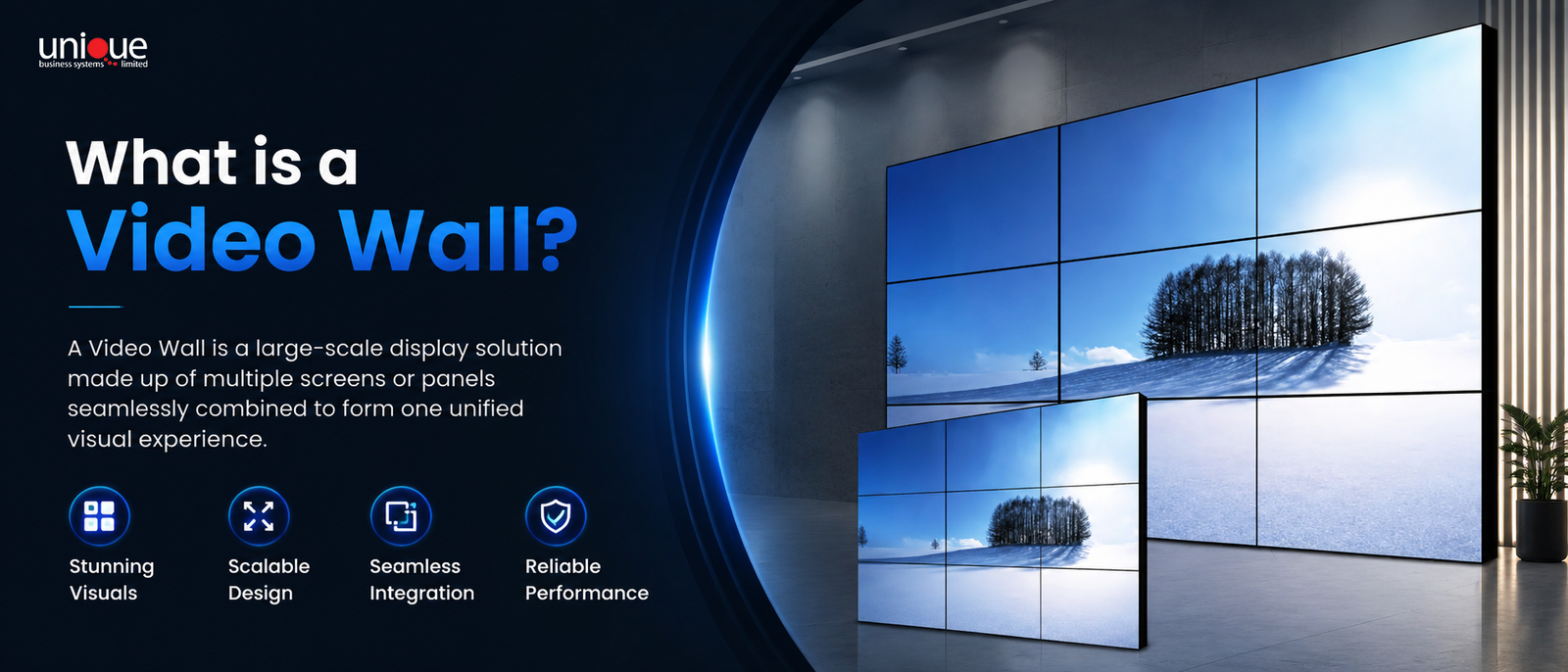
A video wall is a large format display made up of multiple individual screens or panels arranged together - commonly in a grid layout — that work as one unified display surface. Rather than showing separate content on each screen, a video wall controller synchronizes them to display a single large image, video, or multiple content zones seamlessly.
Video walls are widely used as a form of commercial display technology in environments where a standard single screen isn't large or impactful enough — control rooms, retail spaces, event venues, and corporate lobbies, to name a few.
Unlike a single television or monitor, a video wall's biggest advantage is scalability: you can combine as few as four panels or as many as several dozen to create a display exactly the size your space and message require.
How Does a Video Wall Work?
A video wall system relies on three key components working together:
- Display Panels - Individual LCD or LED units arranged in a grid (such as a 3x3 video wall or a 2x2 setup) that combine to form one large image.
- Video Wall Controller - The hardware or software that splits and synchronizes content across all panels, ensuring the image aligns correctly and plays without lag or misalignment.
- Content Source and Management Software - This could be a media player, computer, or content management system feeding video, images, or live data feeds to the display.
The controller is what makes a video wall function as a single canvas instead of several disconnected screens - precisely mapping each portion of the content to the correct panel.
LCD vs LED Video Walls: What's the Difference?
One of the most common questions businesses ask when planning a video wall installation is whether to choose an LCD video wall or an LED video wall. Both have distinct strengths depending on the use case.
LCD Video Walls
- Built using LCD panels with thin bezels, arranged in a grid
- Offer excellent image clarity and color accuracy at closer viewing distances
- More cost-effective for indoor applications like control rooms, retail displays, and lobbies
- Bezels (even ultra-thin ones) are slightly visible between panels
LED Video Walls
- Built from small LED modules that connect seamlessly, with no visible bezels
- Deliver a truly seamless image, ideal for large-scale, high-impact displays
- Better suited for both indoor and outdoor use, with higher brightness levels for outdoor visibility
- Typically a larger upfront investment compared to LCD setups
In short: LCD video walls are often the practical choice for indoor spaces with closer viewing distances and tighter budgets, while LED video walls are better suited for large-scale, high-visibility installations where a completely seamless image matters most.
Common Video Wall Configurations
Video walls are typically described by their grid layout - the number of columns by rows. Some of the most common setups include:
- 2x2 video wall - A compact four-panel setup, ideal for smaller spaces like meeting rooms or reception areas
- 3x3 video wall - A popular nine-panel configuration offering a strong balance of size and impact, commonly used in control rooms and retail environments
- 4x3 or larger configurations - Used for large-scale installations such as command centers, event stages, or large retail flagship displays
The right configuration depends on your available space, viewing distance, and the type of content you plan to display.
Benefits of Video Wall Displays
1. High Visual Impact
A large, unified display naturally draws more attention than multiple separate screens, making video walls ideal for branding, advertising, and high-visibility environments.
2. Flexible Content Display
Video walls can show a single large image, split into multiple content zones, or display different feeds simultaneously - offering far more flexibility than a standard digital signage wall.
3. Scalability
Businesses can start with a smaller configuration and expand the video wall over time, adding panels as needs grow, without replacing the entire system.
4. Reliable, Long-Term Performance
Commercial-grade video wall panels are designed for continuous, 24/7 operation, making them significantly more durable than consumer-grade televisions or monitors.
5. Real-Time Data Display
In control rooms and command centers, video walls can display live feeds, monitoring dashboards, and real-time data simultaneously - critical for time-sensitive decision-making environments.
Video Wall Applications in Business
Control Rooms and Command Centers
Utilities, security operations, and transportation authorities rely on video walls as a control room display to monitor multiple live data feeds and camera systems simultaneously.
Retail and Shopping Malls
Retailers use video walls for high-impact advertising, product launches, and immersive brand experiences that standard screens simply can't achieve.
Corporate Lobbies and Offices
Businesses use video walls to display branding, company updates, or welcome messages, creating a strong first impression for visitors and clients.
Event Venues and Exhibitions
Video walls are widely used at trade shows, conferences, and live events to display presentations, branding, or live event coverage at scale.
Broadcast and Command Center Environments
Newsrooms and command centers use video walls as a command center display to monitor multiple live broadcasts, feeds, or data streams in real time.
Choosing the Best Video Wall Solution for Your Organization
When evaluating commercial video wall solutions, consider the following:
- Viewing distance - Determines whether an LCD or LED video wall is more appropriate
- Indoor vs outdoor use - LED panels handle outdoor brightness far better than LCD
- Content requirements - Static branding, live data feeds, or a mix of both
- Budget - LCD video walls typically offer a more cost-effective entry point
- Scalability needs - Whether the video wall may need to expand in the future
- Installation and support - Reliable video wall installation and after-sales support are essential for long-term performance
As demand for large-format visual communication grows, video wall installation in Bangladesh is becoming increasingly common across control rooms, corporate offices, and retail spaces - reflecting a broader shift toward more advanced visual communication systems.
A video wall is far more than just several screens placed side by side - it's a seamless display solution designed to deliver high-impact visuals, flexible content management, and reliable long-term performance. Whether you're comparing LCD vs LED video walls, planning a 3x3 layout, or exploring options for a control room, retail space, or corporate lobby, understanding how the technology works is the first step toward choosing the best video wall solution for your organization's needs.